Explore Madrid
Spain's lively capital, with famous museums, late-night restaurants and the country's biggest job market.
About Madrid
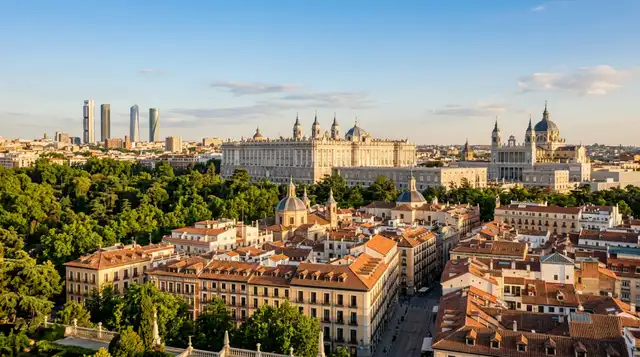
Madrid is Spain's capital and one of Europe's liveliest cities: world-class museums, parks, restaurants open late into the night, and a growing international community. It is also the country's business centre, with many jobs, international schools and excellent healthcare.
The city is the hub of Spain's transport network. High-speed trains run from Madrid to almost every major city, and Madrid-Barajas airport has flights all over the world. Within the city, the metro is fast, cheap and covers almost everything. The climate is continental: hot, dry summers and cold, sunny winters.
That popularity has a price. Madrid asks €6,471/m² (September 2026), among the highest in Spain. In return, the Community of Madrid has some of the lowest taxes in the country: a 6% transfer tax and full relief from its regional wealth tax.
What to know first
- Spain's capital, with culture, jobs, international schools and flights everywhere
- The hub of the high-speed rail network and an excellent metro
- Among the highest prices in Spain, at €6,471/m²
- A 6% transfer tax and full relief from the regional wealth tax
- Hot, dry summers and cold, sunny winters
Asking prices compared
Ranked on asking price per m². Municipalities and sub-municipal entries are listed apart, because a district cannot be ranked against the municipality that contains it.
| Place | Asking price / m² | Population | Price tier |
|---|---|---|---|
| Whole municipalities | |||
| Madrid | €6,471/m² | 3,477,497 | Premium |
How the prices spread
Madrid is the only town on the site in the Community of Madrid. Its average hides big differences: central districts such as Salamanca and Chamberí ask far more than the outer districts in the south and east. Commuter towns outside the city are cheaper still.
The table shows average asking prices, not sale prices. Within one town, prices can vary a lot from one area to the next.
Who each part suits
Life in the capital
A world city with culture, jobs, international schools, an excellent metro and flights everywhere.
Cities in Madrid
Browse properties by city
The case for
- A world capital
Museums, theatres, restaurants and nightlife on a European scale.
- Jobs and international schools
Spain's business centre, with many international schools.
- Excellent transport
A fast metro, high-speed trains in every direction and flights all over the world.
- Low regional taxes
A 6% transfer tax and full relief from the regional wealth tax.
- Lots of sun
Dry, sunny weather for most of the year.
The case against
- High prices
Madrid is among the most expensive cities in Spain, and prices are still rising.
- Hot summers
July and August are very hot, often above 35°C.
- Cold winters
Winters are cold, with frost at night.
- No sea
The nearest beaches are several hours away; Valencia is about two hours by high-speed train.
- Limits on holiday lets
Madrid city strictly limits new holiday rentals, especially in the centre. Check before you buy to let.
Questions buyers ask
- What taxes do I pay when buying?
- On a resale home, 6% transfer tax. New-build homes pay VAT instead of transfer tax. The Community of Madrid also fully relieves its regional wealth tax, though a national tax can still apply to very large fortunes. Ask a tax adviser about your situation.
- Which neighbourhoods are most expensive?
- Central districts such as Salamanca, Chamberí and Retiro ask the highest prices. The outer districts in the south and east are clearly cheaper.
- What is the climate like?
- Continental: hot, dry summers and cold, sunny winters, with little rain.
- Is Madrid good for families?
- Yes. Madrid has many international schools, good healthcare, large parks and excellent public transport.
- Can I let my flat to tourists?
- Madrid city strictly limits new holiday rentals, especially in the centre. Check the rules for the specific building and district before you buy.
Where you might be better off elsewhere
If you want city life with lower prices, Castile and León and Castilla-La Mancha are next door: Toledo is half an hour away by high-speed train and Valladolid about an hour. If you want a big city by the sea, Valencia, Barcelona and Málaga are the alternatives.